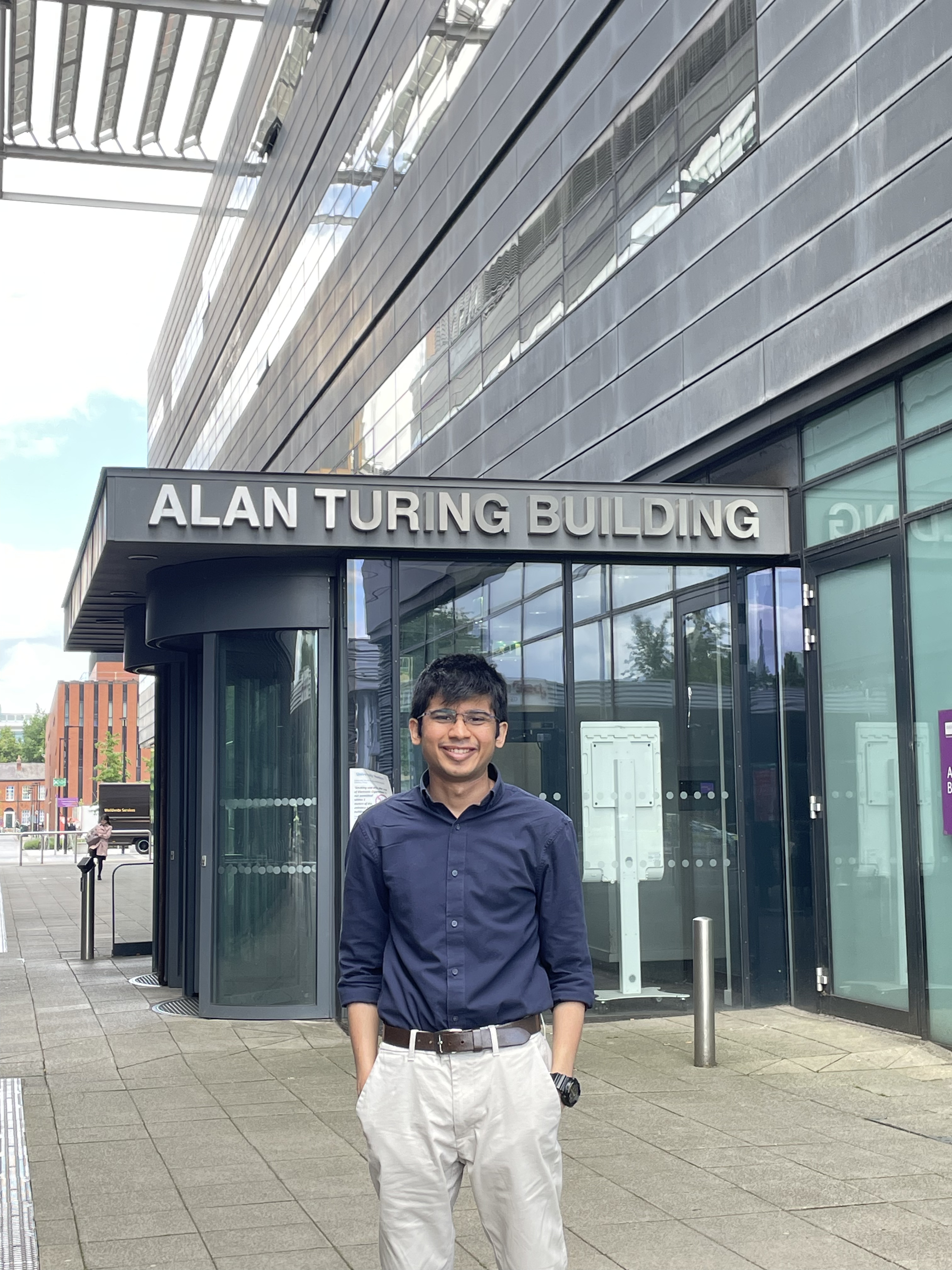
Manav Madan Rawal
Biography / Research
I am a doctoral student in the Lattice QCD and Numerical Field Theory Simulations group at Bielefeld University, under the supervision of PD Dr Christian Schmidt-Sonntag. My work focuses on finite-temperature lattice QCD and machine-learning methods for lattice field theory.
I hold a Master of Science (MSc) in theoretical physics from the University of Glasgow and a Bachelor of Science (BSc) in physics, mathematics, and chemistry from St. Joseph's College (Autonomous), Bengaluru City University, Bangalore, India.
I was previously a research intern in the Particle Theory group at the University of Glasgow, where I worked with Prof. Chris Bouchard on lattice QCD and normalising flows.
Before that, I studied top-quark decays for my MSc project under the supervision of Prof. Andy Buckley. I focused on the discriminating power of colour-flow observables, such as jet pull and the jet colour ring, in probing non-perturbative phenomena such as colour reconnection using Monte Carlo simulations. This work was carried out in the Particle Experiment Group at the University of Glasgow's School of Physics and Astronomy.
My research interests lie broadly at the intersection of quantum field theory, geometry, and scientific computing, with a particular focus on non-perturbative QCD, lattice gauge theory, and machine-learning methods for lattice field theory.
Notes
I have written notes on general relativity, quantum field theory, group theory, and other topics in theoretical physics. They prioritise physical intuition and conceptual clarity rather than presenting derivations without motivation. Having experienced the difficulty of learning from opaque textbooks myself, I aim to make these subjects more approachable for students facing the same struggle.
I compiled most of these notes during my master's degree, drawing freely on explanations from a wide range of sources, including Misner, Thorne, and Wheeler (MTW); Peskin and Schroeder; lecture notes by David Tong and Chris Bouchard; and YouTube channels such as Eigenchris. These are personal working notes rather than polished textbooks, so I may have overlooked details or made mistakes. If you spot anything that should be corrected, please let me know. The notes are linked below and collected on the Notes page.
Academic Genealogy
My academic family tree is a rather crowded seminar room. Beginning with my PhD supervision under Christian Schmidt-Sonntag at Bielefeld University, its lattice QCD branches run through Frithjof Karsch and Edwin Laermann before winding back through figures such as Helmut Satz, Harry Lehmann, Friedrich Hund, Max Born, Peter Zerwas, Helmut Faissner, Walther Bothe, and Max Planck. Follow the chalk dust farther and the tree reaches David Hilbert, Niels Bohr, Ernest Rutherford, J. J. Thomson, Hermann von Helmholtz, Gustav Kirchhoff, and other architects of modern physics and mathematics. It is both delightful and slightly intimidating to find my present-day lattice calculations sitting at the end of conversations that helped shape quantum mechanics, atomic physics, electromagnetism, and mathematical physics—no pressure, then.
Max Born and Niels Bohr are my academic great-great-great-great-grandadvisors, while David Hilbert is my academic great-great-great-great-great-grandadvisor. My full academic tree can be found here.